Animals Out Of Context
It can only be that this chronic disease, like other forms mentioned elsewhere in this site, has come from our deviating from the wild model, raising our pets in ways that are quite different from that of their ancestors and wild cousins, the wolf and bobcat.
Many of these differences are mentioned throughout this website, notably in Feed for Vitality, Vaccination:Safety, Drug Free Heartworm Prevention, and Non-Toxic Flea control, all areas of man's intervention. When you read these areas and thoroughly understand who we have in our households for pets, this section will make all the more sense.
A Simple Secret
So, the best-kept secret for dental prevention is simply this: feeding raw bones.
Regularly. Ideally daily. Why? Because this is an important missing ingredient in the diets of your pets that would be a natural part of every wolf's diet. Once the meat and organs and digestive contents are finished from the prey they have successfully killed, chewing the bones would occupy a fair amount of time for these wild canids.
And, as they gnaw away on raw bones, what does your dog or cat receive?
An excellent source of available calcium, for one thing. One that balances the high level of phosphorus that is present in the meat. And a whole host of other good things, including blood building nutrients from the marrow, other minerals, enzymes, proteins, essential fatty acids, immune enhancing vitamins, and bulk to help the bowels stay clean and the anal glands empty.
But what they receive physically is the best toothbrush available in the world! All that gnawing is literally scraping the tooth surfaces with a tooth friendly similar substance, a semi-hard polisher of enamel, and is a great exercise for the jaws and gums.
Good for Body, Good for Mind
Ever notice how content an animal chewing a bone looks? Eyes half closed, purposefully, peacefully gnawing away at something too big to eat in a couple of bites, these guys are in pure bliss.
I highly suspect that if we measured, we'd find gobs of endorphins coursing through the blood vessels of these lucky savages.
["Gobs" is Missouri-ese for lots. Forgive me, that's where I went to vet school]
And guess what would be the happiest distraction of all when you're leaving in the morning for work, and your "pack member" has to stay home alone? You bet. That big raw bone!
Sniff, Sniff. Ahhhh.
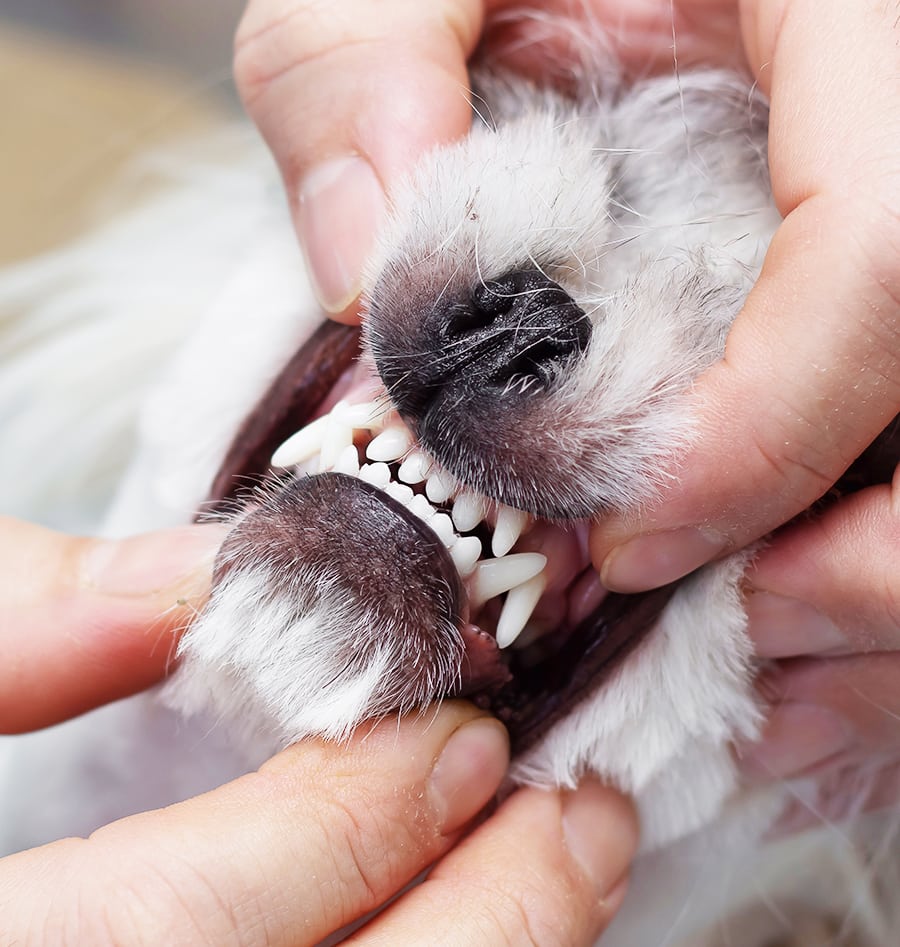
You’ll see a wondrous thing when you look in the mouth of a dog or cat that eats raw bones. My patients who do this are, without exception, sweet in the breath and white in the tooth.
And their gums are a healthy pink, not red, not receding from the teeth, but hugging them as they should be, and never bleeding. These are the hallmarks of an animal who will never need to see a dentist!
How to Feed Bones
(I’ll mostly speak of dogs here, but cats can and should eat raw bones as well, just smaller ones, so keep reading if you are a cat caretaker.) If your dog is brand new to the idea of eating raw bones, it’s best to start gradually. The excitement of something so new and tasty can lead to over consumption and resulting constipation at first.
So, a great way to begin is with pieces of raw chicken neck. Start with a half of a neck for the average lab-sized dog, and an inch or two for a chihuahua. Feed this daily, ideally when your dog is between meals or prior to a meal, so those digestive juices are running high.
Is your dog a bit too eager, and wants to inhale the whole neck? A good plan for these snarfers is to hold the neck in your fist, and let them work it slowly at first. As they get the idea that this is going to be a regular occasion, they’ll slow down and can be trusted to be more thorough in the chewing.
After a daily dose like this and seeing that the stools are not too hard, graduate to bigger pieces. That lab could have a whole neck or a drumstick next, meat and bone together, which could replace part of a meal.
By that I mean you can feed less of the food you normally offer to offset this well-balanced offering. The cats and smaller mouthed dogs do well with chicken wings. And venture out into other kinds of bone, including turkey, pork, lamb, even beef, but always, always raw.
The closer you get to daily feeding, the healthier your pet will be, and the fresher the breath and cleaner the teeth. But even several days a week is a gracious plenty. [Okay, that slipped in from a Mississippian clinician who taught me large animal medicine in Missouri. But it has a nice ring to it, don’t you think?]
Old Family Tales
Did you grow up hearing that, of all things to never do, you should never, ever, I mean not at all, feed chicken bones to your pet? That they would splinter and break and poke holes in the gut and necessitate surgery and maybe result in death? I did.
Our dogs got a few steak bones here and there, but never, never chicken bones. And they never had great teeth, though dentistry wasn’t such a big thing as it is now.
And I preached this no poultry bones idea faithfully to my clients, even after I began holistic practice in the early ’90s.
Preached it until I heard repeatedly from people that they had fed poultry bones to generations of dogs without problems.
Really? No Perforated Intestines?
It took a while to sink in, but I finally had to take my mind back to the drawing board. I asked myself, “Would a wolf eat a wild turkey?” Absolutely.
And, in eating that bird, would he eat the bones, too? Of course.
And did I ever hear of wolves dying of perforated intestines from this practice? No, never.
Could it be, then, that they were “built” to handle this, that nature designed these scavengers with digestive systems that could process poultry bones? It had to be the case.
So, I evolved to preach only that cooked poultry bones were a no-no, but encouraged raw. (And I’ve recently heard from another client that they’ve fed the cooked ones successfully for a long while… You decide. I wouldn’t harbor a great fear of this practice.)
Broken Teeth?
Concerned about breaking teeth? Perhaps you have a dog who’s already lost or broken some teeth? This is a problem in some unhealthy animals. Due to poor nutrition and vaccinations, they don’t have strong teeth. “Neck lesions,” aka FORLs, decay where the gum meets the tooth, are known to be caused by vaccines.
In these cases, you may never be able to graduate to the harder, larger bones, but chicken necks will still be a very usable bone for these animals. Beef bones are generally from older animals and are naturally harder, so they can be avoided in any animals you are unsure of as to dental strength.
But there are many, many dogs who thrive on these “all day suckers!” And what a great occupation when there’s nothing else happening in their world. I suspect that if you offered your dog a toothbrushing session or a bone, it’d be no contest!