
Stop Killing Your Pet: The Top 5 Ways – Part Two
The food you offer your pet is entirely up to you as chief caretaker. And yet, part of your animal “remembers” what’s appropriate to eat, and you, as her caretaker, have to find your way through the maze of choices and ideally match that “memory” of the perfect food with your offering.
Big responsibility. They “are what they eat,” and you want to make good choices here. Your animal’s health and longevity depend on your choices.
When you do the feeding wrong, you are killing your pet. Slowly, sure, but that’s the direction, away from Vital.
The Context You Make Choices In
We live in a trendy, market driven society. A society where, at least for the last 60 years, you’ve been bombarded with advertisers making claims and offering up catchy jingles and slogans in order to influence your purchasing decisions.
That’s slowly changing, but you’ll do well to push that curve and outthink the marketing hype when you buy natural pet food. Or, not “buy” it at all.
Who’s That Circling the Food Dish?
The truth is, if you’re feeding a dog, you have a modern day wolf getting excited around feeding time (or maybe not excited, depending partly on what you’re offering).
Recent studies have matched some 99% of the domestic dog’s genes with those of the wolf. Your pooch, what ever breed or mix she is, has the digestive system (and food needs) of the wolf.
Can you imagine your cat as lynx or bobcat as well? Easy, right? The “domesticated” (ha!) cat, similar to her wild ancestors, is clearly built like a hunting machine. From her sharp, pointed teeth and claws to her raspy tongue made to lick meat from bones, she’s clearly showing her wild inheritance through and through.
The important point is not to confuse the cutest modern versions of the wolf or lynx who live with you as somehow “changed” digestively. They are not.
Bred for Appearance. Only.
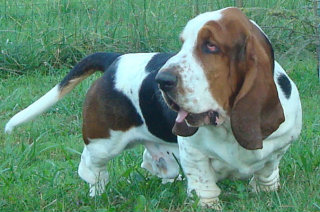
The cute or otherwise non-wild look of our modern dogs and cats is the result of mankind’s genetic selection. Selection for only that: appearance.
Society has decided, over the past tiny fraction of time (100 years or so) that certain features in domestic dogs and cats are “desirable” and likely to be purchased.
We like the cute, round heads of dogs that resemble human babies.
To whit, the Cavalier King Charles Spaniel.

We might like the long, silky haired, short-nosed Persian or Himalayan cats.

In “voting with our wallets” for these appearances, entire breeds have been created and propagated. And boy, did we select some that looked different from the ancestors!
But, (and here’s where you’ve got to be a smart, thinking consumer),
We have not changed the digestive system of our pets from the wild model.
Not one iota.
Why? Because we (or rightly, pet breeders) have not selected for anything other than appearance. And maybe behaviors, to a lesser extent.
You know, the loving, affectionate lap dog or cat companion who’s in heaven being close to you and receiving your petting. “Oh, wait, don’t stop!”
So, Whatcha Gonna Feed Your Wolf?
Cereal? Dried, manufactured, food like particles?
That’s what you find in the pet food aisle of every grocery store. Every PetSmart, Petco, WalMart, etc. has a whole lot of shelf space given to this stuff. These foods fuel the multi-billion dollar pet food industry.
That’s billion, with a B.
Picture manufacturers, cheek by jowl racing pet foods to market, watching your wallet-voting behavior as they develop the next “100% Complete!” or “All Natural!” pet food for your wolf or lynx to eat.
“Now, With Antioxidants!” Or, it might be more subtle, with a gorgeous picture of a cornucopia of food on the label that looks amazingly delicious. And blueberries on the label (coming somewhere after zinc in the ingredient list!).
Or, will you choose something smarter, something more closely resembling ancestral food?
Your Food Choices Could Be Killing Your Pet
Kibble, the pelleted food-like particles so commonly sold for pets, are often a detriment to your wolf’s or lynx’s health. Even in those touted as natural, pet food often has two big problems.
- They are often toxic.
If the words “byproducts,” or “digest” are on the label, it means meat sources unfit for humans to eat.
Including the “4-D” meats. From Dead, Diseased, Dying, or Disabled/Downer animals who are condemned and rendered for pet food.
Who uses this horrible stuff? Common brands. Here’s a Science Diet prescription food’s label for “Healthy Advantage”:
Here’s the first couple lines, highlighted for you:

- They are dead foods. Lifeless.
Remember that wolf you own? That lynx sprawled out on your bed?
They are genetically “remembering” and genetically “expecting” live food.
Because that’s what all the ancestors ate, who passed their digestive genes on to your pal who now lives in the house with you.
To overstate the obvious: Prey never runs into a fire before the predator eats it.
Most importantly, perhaps, they are manufactured and sold based on myth. Even most so-called natural pet foods.
When Myths Rule, Pets Die Early
The mother of all myths, especially prevalent since the post World War II days, is that “Science Knows Best.”
You know, the myth that we can solve all our problems and feed the world and kill all the pests with the right stew of chemicals and scientific know how.
That myth brought us
-
Wheaties, The Breakfast of Champions, that leaves you hungry by mid-morning and insulin resistant long term.
-
Hybridized wheat that yields record bushels per acre, but brings you inflammatory gluten that makes your joints ache and is incriminated in Chrohn’s, aka Inflammatory Bowel Disease.
-
DDT that wiped out beneficial insects and birds of prey along with its intended target of bedbugs or mosquitoes.
How does that myth play out in your pet’s food dish?
It shows up in pet food like Science, sold by veterinarians, and trumpeting “100% Nutritionally Complete” on the label.
Did you know that untold cats have suffered or died of taurine deficiency related heart failure (and/or blindness) on food from this company (and others you know) that assured us it was 100% Nutritionally Complete? True.
The well respected journal, Science, in 1987, when this first came to light, opened the article with the words, “Thousands of pet cats die each year with dilated cardiomyopathy…”
The link was clearly made between diets supposedly 100% complete, but actually being taurine deficient, and causing disease and death in thousands of pets.
Oops.
The myth of Science Knows Best would also have you feeding just one factory made food with nothing added for the life of your animals.
Imagine hearing such advice from your pediatrician: “Offer only this formulated, prepared diet to your child, with nothing fresh added.” Would you do this for your child?
Of course not! You’d run to a another pediatrician in a heartbeat!
Survive vs. Thrive
Pets can live on these diets, certainly. They do all the time. But these foods don’t “Build Vital Animals Twelve Ways!” Or even one way. In fact, these foods create chronic ill health, and hasten death.
You want more than survival, presumably, or you wouldn’t be here.
To grow a vital animal, the secret is this:
Feed the Need.
The need is the call of wolf, the yowl of the lynx, the wild digestive system’s demand for Real Food.
Lumper that I am, I offer you two broad ways that you can answer the call of the wild, and help your animals to thrive:
-
Buy it prepared, raw and balanced.
-
Make it balanced with raw ingredients.
There are several choices out there for buying it ready made. This is easy and more costly than Way #2.
Here’s some recommended training on how to make it at home. This is more work and cheaper than Way #1.
Final Stop: Stop Feeding the Same Thing Always.
Think about the predators in your home. Their ancestors never ate a mono diet.
When the caribou thinned out or moved off the wolf’s range, they moved to voles. Or rabbits. Or birds eggs. Day to day, choices varied.
You’ll do well to follow at least a monthly rotation of protein sources. Whether you buy or make your balanced raw food, change it up. You might do beef month, followed by turkey month, followed by lamb or venison or chicken. Then repeat the cycle.
Even supplements should be changed periodically. Adding some kelp for iodine? Give it a rest and add some shell fish for a while. Using salmon oil for those wonderful EFA’s? Try a mix of other fish oils that has no salmon in it as a rotation. Be creative, be smart.
Change is built in to the wild guys’ diets. Follow that example for your vital animal to thrive.
In the comments, tell us what’s working for your vital animals. Do you feed prepared raw diets? Whose do you like? Do you find one person’s recipes easier and more sensible to you than the rest? Give us the scoop!
[Next up in this series: Stop Using Pesticides to Kill Fleas]