
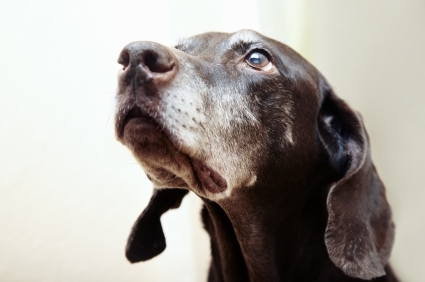
Got senior-itis? No, not the “itch to get out” that senior high school students experience, I’m speaking of the senior dog or cat who’s getting gray around the chops, sleeping more, jumping less.
Surprisingly, the “senior” category has dropped lower and lower in conventional medicine, so now many dogs and cats are considered senior by age seven!
Juliette de Bairacli Levy, the famous herbalist crone who died a few years back at age 96, raised her Afghan hounds in the 30’s using in ways that would only later be termed “holistic.” Using natural rearing methods that included raw diets, herbs, and regularly fasting, these dogs often lived well into their twenties!
Now, you know the bigger breeds today are often considered quite old if they make it past ten years. What’s going on here? And more importantly, how can you keep your dog or cat with you for the longest, most vital life possible?
Low Protein Caribou, Mice?
One of the central marketing scams of the last twenty years or so would have you believe that you need a different bag of food for a pup or adult or senior dog.
I’d urge you to look at the wild ancestors and cousins, (as I like to do for reference) and ask yourself:
Do wolf pups or lynx kits somehow get brought higher protein caribou or mice? And conversely, are the aged members of pack or pride somehow finding low protein versions of the prey they thrive on?
Crazy thought, right? Prey is prey, no matter your age. And the genes of the wild cousins are almost identical to our modern day pets, right? I submit that this “senior dog food” idea is pure marketing, and one to avoid.
Conventional veterinary medicine often gets this way wrong in cats, thinking low protein is somehow healthier in the aged. This is not even true in most cats with kidney disease, as we’ve learned from those who’ve been allowed to eat balanced raw, mostly meat diets. (Hint: they blossomed!)
How to feed your senior dog or cat
1. Use species appropriate food.
That means prey-like food, especially important for the “obligate carnivore,” that little lynx who lives in your house. Use your logical thought process here:
What’s prey made of? Can I mock it up in the food dish?
I usually paint in broad brush strokes here. Prey is roughly:
-
60-70% muscle and bone by mass
-
Probably about 20% organs, and maybe
-
10% vegetation in the stomach and intestines.
Then, factor in that, at least in the big prey like caribou or reindeer, the wolf shakes that huge mass of stomach contents all over the ground before eating, and you’ll see that broccoli shouldn’t make up half of your pet food, right? Great for you, and some is fine for your dog or cat, but in very low proportion to the whole diet.
You can make this at home and not be far off, changing ingredients periodically, rotating say a month on chicken, a month on beef, a month on turkey, and back again. Lots of books out there to guide you and lots of great frozen prepared choices, some delivered right to your door on dry ice!
2. Less food as activity declines (prevent obesity)
This is also true across species lines, and should be common sense (though, as my friend John says, “Common sense is often not very common”). Obesity is a health impediment. Don’t go there.
A broad brush stroke that works for most, regardless of age:
–> Feed that amount that’s quickly gobbled up (5 minutes or less for dogs, 20 minutes or less for cats) and your animal’s weight is where it should be.
Leaving food at each meal, and weight is normal? Feed that much less till it’s finished.
Good measures of weight:
Dogs: a normal, indented or at least parallel waist, no bulges
Cats: no fat pad on the lower belly, no bloated belly
Both dogs and cats: a spine whose “bumps” you can feel with moderate pressure. Too skinny makes a very prominent bumpy spine, too fat makes it hard to find those bumps.
How often to feed:
-
under 30 lbs, twice daily
-
over 30 lbs, once daily
3. Kindle the “Low Digestive Fire”
It’s not unusual for the older pets to have trouble digesting food, and that can be helped by adding enzymes to each serving. This is especially true in the case of kibble fed pets, as kibble is cooked, by definition. Enzymes are amazing catalysts that help extract nutrition locked up in food.
The addition of enzymes can mean such efficient digestion that you can cut back further on portion sizes. See #2.
I like to see probiotics, the friendly bacteria, be a regular addition to all animals, and senior pets are no exception. You can often find enzymes and probiotics together in one supplement. Here’s one I like.
Other goodies
You may want to add a good source of essential fatty acids (EFA’s) of the omega-3 class. They are anti-inflammatory by nature, helpful for immune balance and good for coats. I like fish oils for the carnivores, flax is fine for the humans. Two good brands I’ve trusted over the years are Carlson’s and Standard Process. I take their Tuna Omega 3 and share it with my patients!
Senior Dog/Cat Joint Help
In all animals, seniors included, it’s important to provide regular exercise opportunities. Sometimes joint aches get in the way of enjoying that.
I had a dog patient years ago who was quite lame, in multiple joints as I recall. We tried the usual supplements with glucosamine and tried remedies, but weren’t doing very well controlling this discomfort.
Her savvy owner took things into her own hands and starting feeding knuckle bones from poultry, full of lots of cartilage, and the old dog never looked back, getting significantly more limber and staying that way as long as she fed them! Chicken feet, a cheap source, are loaded with joint helping compounds, albeit a bit gross.
A dog supplement that’s showing promise, if chicken feet give you cold feet, is Wag, a natural, tasty joint supplement based on egg membrane, boswellia, curcumen, and chelated minerals. They’ll send you a free two week trial sample and guarantee results, so click here to give them a try.
One for cats that I’ve seen work really well is Nu-Cat from Vetri-Science. Largely food based, which I like, based on perna, the green lipped mussel.
Stop Vaccinations!
Have an already vaccinated dog or cat? Got a few rounds in his youth, but at over four months of age? Then there’s no need to keep repeating that and there’s harm in doing so.
Are you running titers? Fine, just don’t make this mistake in your senior animal:
“Her titer dropped off, so I re-vaccinated her.”
Big and risky mistake. Read what titers fail to measure on this page.
Keep The Cancer Cells in Check
You and me and every animal we can name is thought to have cancer cells arising on a regular basis. We are not all dropping over of cancer though, and here’s why:
Our immune systems “see” these cancer cells as foreign, and kill them.
As we age, our immune system, like the rest of us, tends to run a bit less efficiently. That’s probably why cancer is the #1 cause of canine death overall, according to a very large study published in 2011, looking at 74,000 cases of canine death spanning the twenty years prior to 2005.
Immune support that’s got research behind it makes logical sense in the senior guys. You can see what I think is the best immune support for all species by clicking this link.
Seniors, Like Everybody: No Poisons!
Let’s face it, there’s a chance to poison your pet in the name of prevention at every step. It becomes even more important in the oldsters to avoid this, as detoxification is more challenging to the older set.
The Big No-No’s:
Flea Control. You already know this, but isn’t it tempting to believe the ads that make it look so easy and safe to just puts some drops on her shoulders? No way, babe.
Heartworm Prevention. If you haven’t read about the dangers of the monthly tablets or the safe way to effectively prevent this parasite, please, don’t wait another day: buy this book! I wrote it from years of veterinary experience living where heartworm lives, keeping my patients free of the parasite and free of the drugs’ potential damage.
Pure water helps. Pure food, of course. And take care of those teeth, naturally.
What else old buddy? You’ve given me so much love and companionship for so many years. You want a little scritch on your neck? Right behind the ears? C’mere, I got something for you.
Have any favorite things you’ve found to keep your senior dog or cat in top shape? Tell us in the comments. We all benefit from what you’ve learned!