
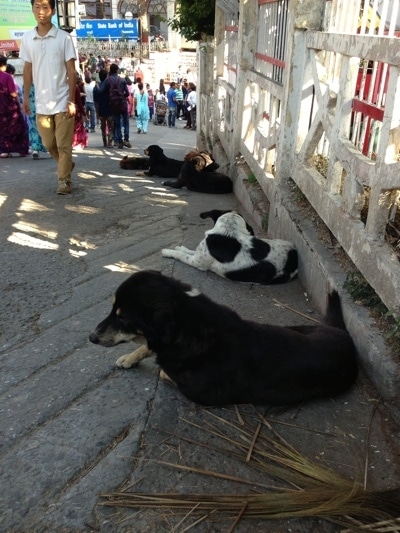
Shoppers walked past the pair unfazed, intent on seeking their desired goods. The dogs seemed as unperturbed as the shoppers, though they looked so vulnerable to me.
The values of different cultures can help inform our own, and travel helps one take one’s boundaries less seriously. There are very few pet dogs in India, most wandering the streets, foraging, sleeping out of the way of traffic, and guarding their territory against dogs who don’t belong. The dogs I saw looked quite fit and vital, making do as opportunist feeders in a world where they are simply accepted as part of God’s creation. Likely, they were untouched by the vaccinations that are bringing so much illness to our domestic canines.
Speaking With Authority
The language of the street dogs of India is like that of another culture as well.
I watched from my friend’s van as a black male street dog approached a yellow male dog who was obviously a visitor, and an unwelcome one at that. The yellow intruder stood firm, and growled a low guttural growl as the black guard advanced, hackles raised, teeth bared, a more menacing and louder tone issuing forth in his warning growl.
What could have been an explosive fight with blood shed was avoided with careful diplomatic skills. The yellow dog, equal in size to the advancing guard, stood erect, ears forward, hackles raised, tail up, but allowed the more menacing black dog to sniff his anus. Once sniffed, without showing the slightest sign of weakness, the yellow visitor moved off in a measured, confident gait. He was clearly deferring to the black dog’s authority, and taking a slightly submissive role, but in no way inviting an attack, launching one of his own, or showing fear or weakness. After passing the wheel of a parked van a bit up the street, he glanced back to see that the guard was not advancing on him, and kept walking calmly away. Violence averted.
A Battle Over Sexual Rights
In another incident, a female in heat ended up provoking a violent fight. She was being mounted unsuccessfully by a male suitor. After several failed attempts, a second, more determined male who been an onlooker mounted and tried repeatedly to gain entrance to her vagina. His efforts finally brought pain to the female, who turned to bite his foreleg to get him to stop. Her cries of pain were like a siren heard by her pack, who suddenly materialized out of nowhere, and a fracas ensued. Apparently the determined suitor was either not of this pack or was a very lowly member, as he was roundly attacked by several males, one in particular who took the lead with ferocious intensity. The attacked male found himself bitten at from all sides, the din of the street fight grew, until finally the underdog was on his back encircled by his attackers. With darting, lightening like lunges, the alpha male unleashed vigorous bites to the underdog’s genitals until the poor dog finally squealed and hobbled off, alone. The group then dispersed, back to the business of being street dogs in man’s world.
One can imagine the genetic implications of such pack behavior. The alpha male’s genes would predominate in this pack, perhaps promoting more vigorous pups suited to survival in the streets of India.
Street Dog Features
Remarkably, street dogs in India all look strikingly similar. They have medium length coats, are mostly black with a few yellow or spotted variants, weigh about 50-60 pounds, have slightly flopped ears and long muzzles. They remind me of German Shepherd mixes without the long coat.
A much earlier trip through Europe and No. Africa in my college days saw street dogs that more closely resembled Pit Bull mixes. I suspect canine appearance varies quite widely depending on locale.
Cancer Spread by Touch?
Another Indian street dog had a likely venereal tumor on the underside of his tail. Canine Transmissible Venereal Tumor is an infectious form of cancer that is found world wide. Imagine: cancer spreading by physical touch, cells from the tumor setting up a new tumor in the dog who came in contact with the “infected” dog. It turns out only two species are known to have cancer that spreads this way: the dog and the Tasmanian devil.
Cancer researcher Elizabeth Murchison has sampled these tumors and found virtually the same genome in them as that which appeared in dogs from 11,000 years back. The tumor appears to have jumped to multiple continents about 500 years ago. How fascinating that this tumor has propagated throughout the world and remained virtually unchanged from continent to continent over such vast stretches of time.
Starch Digestion
It appears from other research that dogs are more able to digest starch than their near ancestors, the wolves. But that certainly doesn’t mean they’ll thrive on it. People have learned the hard way that starches and sugars have been responsible for myriad diseases in our species, from obesity and diabetes to heart disease. I’d not wish those on the dog or cat, the carnivores who walk among us. Feeding kibble has resulted in more of these diseases than those who eat balanced raw diets.
In the end, while cultural differences abound, from dogs being eaten in the Philippines and China to being revered as close family members in the West, to living by their wits on the streets of India, dogs are very much the wolves of our domestic world, their behaviors shaped by circumstance and need.
Have you come across domestic animals living quite differently than those we are used to in the first world? Tell us about it in the comments.